
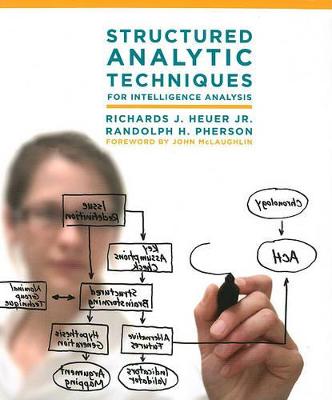
Randolph H. Pherson: Structured Analytic Techniques for Intelligence Analysis [2010]
Logically organized and richly illustrated, Structured Analytic Techniques makes it easy to navigate, reference, and put the tools to use right away. Each technique is clearly and systematically explained: when to use, value added, the method, potential pitfalls, examples of how it can be used, its relationship to other techniques, and its origins.
THE TECHNIQUES
* Getting Started Checklist
* Customer Checklist
* Issue Redefinition
* Chronologies and Timelines
* Sorting
* Ranking, Scoring, Prioritizing
* Matrices
* Network Analysis
* Mind Maps and Concept Maps
* Process Maps and Gantt Charts
* Structured Brainstorming
* Virtual Brainstorming
* Nominal Group Technique
* Starbursting
* Cross-Impact Matrix
* Morphological Analysis
* Quadrant Crunching
* Basic Scenario Analysis
* Alternative Futures Analysis
* Multiple Scenario Generation
* Indicators
* Indicators Validator
* Simple Hypothesis
* Multiple Hypotheses Generator
* Quadrant Hypothesis Generation
* Diagnostic Reasoning
* Analysis of Competing Hypotheses
* Argument Mapping
* Deception Detection
* Key Assumptions Check
* Structured Analogies
* Role Playing
* Red Hat Analysis
* Outside-In Thinking
* Policy Outcomes Forecasting Model
* Prediction Markets
* Premortem Analysis
* Structured Self-Critique
* What If? Analysis
* High Impact/Low Probability Analysis
* Devil's Advocacy
* Red Team Analysis
* Delphi Method
* Adversarial Collaboration
* Structured Debate
* Complexity Manager
* Decision Matrix
* Force Field Analysis
* Pros-Cons-Faults-and-Fixes
* SWOT Analysis
Original: $8.03
-70%$8.03
$2.41Product Information
Product Information
Shipping & Returns
Shipping & Returns
Description
Logically organized and richly illustrated, Structured Analytic Techniques makes it easy to navigate, reference, and put the tools to use right away. Each technique is clearly and systematically explained: when to use, value added, the method, potential pitfalls, examples of how it can be used, its relationship to other techniques, and its origins.
THE TECHNIQUES
* Getting Started Checklist
* Customer Checklist
* Issue Redefinition
* Chronologies and Timelines
* Sorting
* Ranking, Scoring, Prioritizing
* Matrices
* Network Analysis
* Mind Maps and Concept Maps
* Process Maps and Gantt Charts
* Structured Brainstorming
* Virtual Brainstorming
* Nominal Group Technique
* Starbursting
* Cross-Impact Matrix
* Morphological Analysis
* Quadrant Crunching
* Basic Scenario Analysis
* Alternative Futures Analysis
* Multiple Scenario Generation
* Indicators
* Indicators Validator
* Simple Hypothesis
* Multiple Hypotheses Generator
* Quadrant Hypothesis Generation
* Diagnostic Reasoning
* Analysis of Competing Hypotheses
* Argument Mapping
* Deception Detection
* Key Assumptions Check
* Structured Analogies
* Role Playing
* Red Hat Analysis
* Outside-In Thinking
* Policy Outcomes Forecasting Model
* Prediction Markets
* Premortem Analysis
* Structured Self-Critique
* What If? Analysis
* High Impact/Low Probability Analysis
* Devil's Advocacy
* Red Team Analysis
* Delphi Method
* Adversarial Collaboration
* Structured Debate
* Complexity Manager
* Decision Matrix
* Force Field Analysis
* Pros-Cons-Faults-and-Fixes
* SWOT Analysis